Guinier

Guinier

A chain of physical models that follows an aluminium alloy from the melt to the finished sheet.

Thermodynamics, precipitation, strength, multi-alloy sheet: each step is taken from the published literature and checked against measurements before the next one is built on it.

Guinier icon: needle-shaped precipitates seen in an electron microscope

To begin with

A ten-tonne ingot is never quite uniform

As a rolling ingot solidifies, the liquid enriched in alloying elements moves relative to the growing crystals. The centre ends up a few percent poorer in magnesium and silicon than the rest. Can a long anneal even it out?

0.2 mm
how far magnesium diffuses in 10 hours at 550 °C
300 mm
half the thickness of a typical rolling ingot
≈ 2 300 years
what it would take to even out that distance

What casting leaves in the ingot stays in the sheet: the centre of the ingot becomes the centre of the sheet. Questions like this one are what Guinier is for.

Questions it answers

Six questions, six real outputs

Every figure below is produced by Guinier as it stands, by one of its documented examples.

1

Which phases, at which temperature?

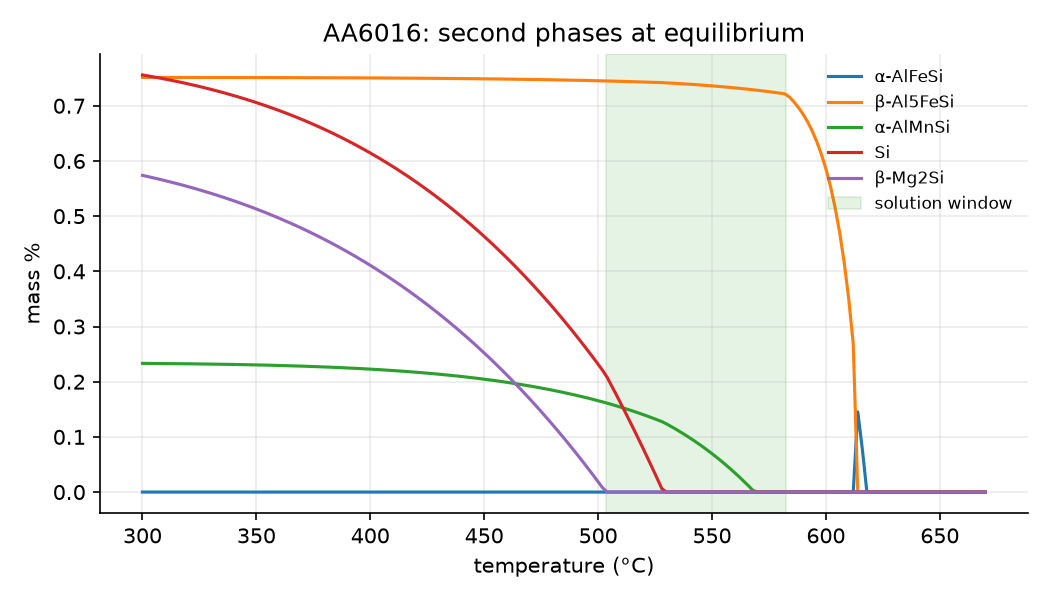
AA6016 is a common alloy for car body panels. To harden it, it must first be heated until its Mg2Si particles dissolve, but never until it starts to melt.

The thermodynamic model puts that window between 503 and 583 °C. The iron-rich particles never dissolve, at any temperature.

Mass fraction of each second phase in AA6016 against temperature, with the solution-treatment window shaded
Equilibrium phases of AA6016, CALPHAD with the COST 507 database.
2

What does scrap iron leave in the cast?

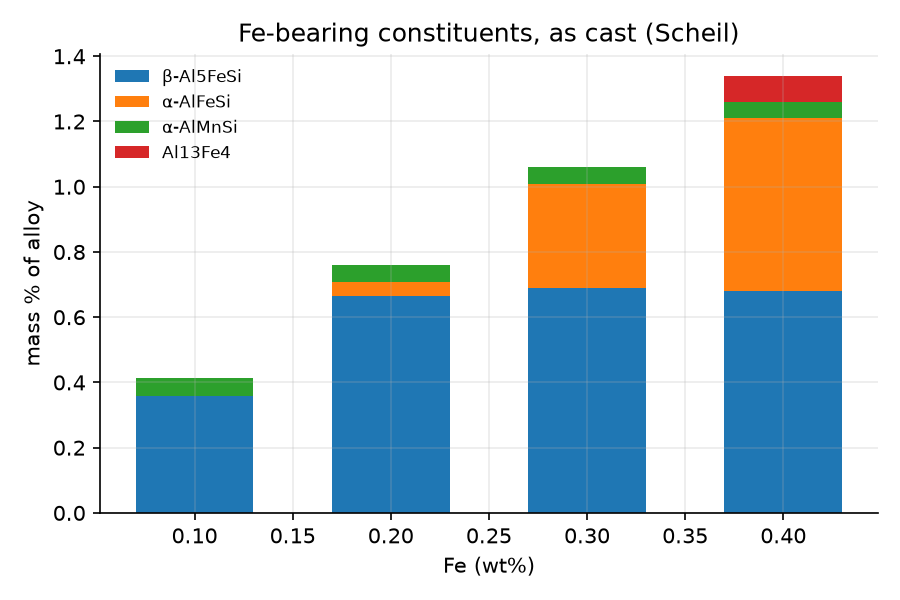
Recycled scrap brings iron, and iron cannot be removed by heat treatment. Simulating the solidification of an AA6016 ingot shows the coarse iron-rich particles tripling, from 0.4 to 1.3 % of the mass, as the iron rises from 0.10 to 0.40 %.

These particles later decide where new grains form during annealing, and where cracks start when the sheet is bent.

Stacked bars of iron-rich constituents for 0.10 to 0.40 percent iron
Scheil solidification of AA6016 at four iron contents.
3

Does the model see what the microscope sees?

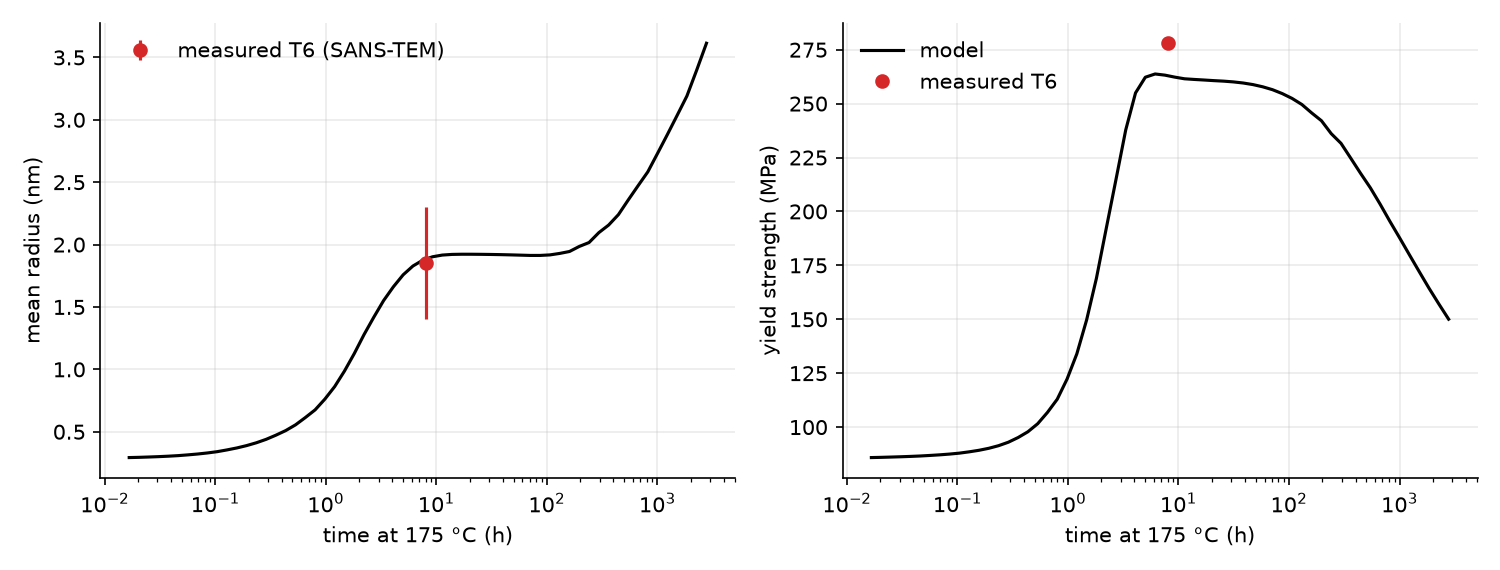
Ageing at 175 °C fills the alloy with needle-shaped precipitates a few nanometres across, and they make it strong. After 8 hours, the model gives needles of 1.9 nm radius occupying 1.5 % of the volume. Neutron scattering and electron microscopy measured 1.7 to 2.0 nm and 1.6 %.

The parameters are the published ones; none was adjusted to obtain this agreement.

Mean precipitate radius and yield strength against ageing time at 175 °C, with the measured T6 state
AA6061 aged at 175 °C, compared with the measurements of Bardel et al., Acta Materialia 62 (2014).
4

What does a weld do to a hardened sheet?

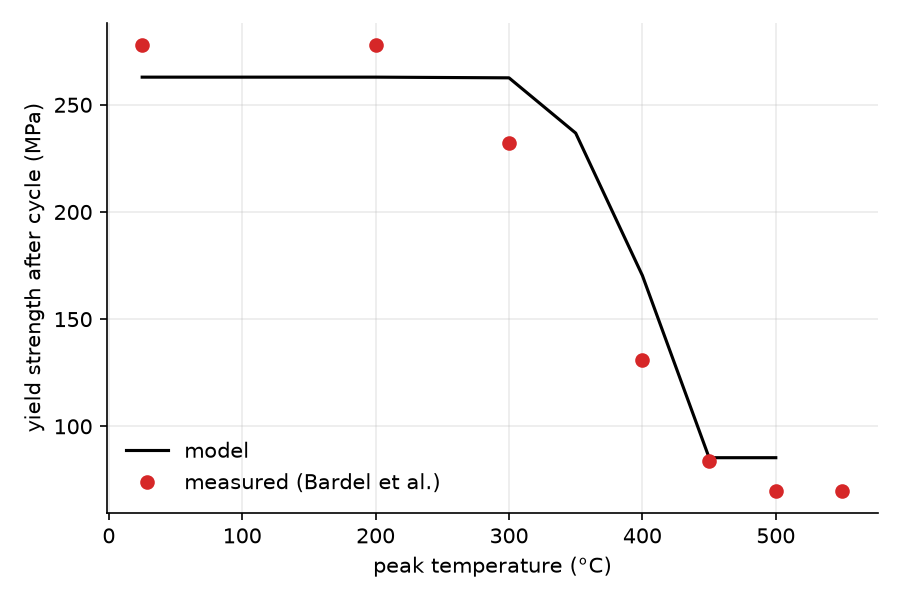
Next to a weld, the metal is heated for a few seconds only. That is enough: above about 450 °C the precipitates dissolve, and the sheet falls back to a third of its strength.

Below 300 °C, nothing happens. The model follows the measured trend, and is somewhat too strong between 300 and 400 °C, where more stable phases the model does not represent start to form.

Yield strength after a rapid heat cycle against peak temperature, model and measurements
Heating at 15 °C/s, natural cooling; red points measured.
5

What does iron cost in strength?

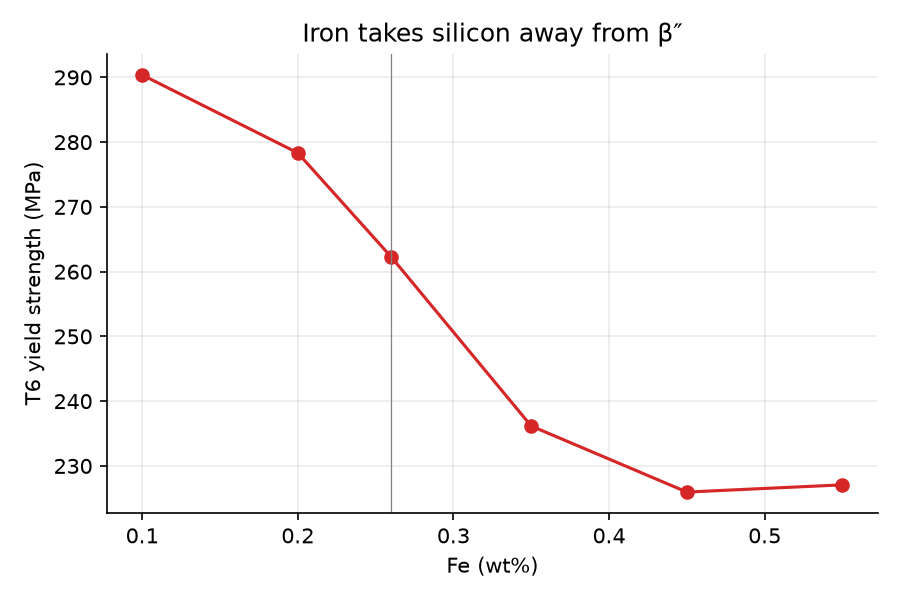
Iron-rich particles also hold silicon, which would otherwise go into the hardening precipitates. Chaining the thermodynamic model to the precipitation model puts a number on it. From 0.10 to 0.55 % iron, an aged 6061 loses about 60 MPa.

The same chain tells how much silicon to add back.

T6 yield strength against iron content
Thermodynamics → available silicon → precipitation → strength.
6

Two alloys in one sheet?

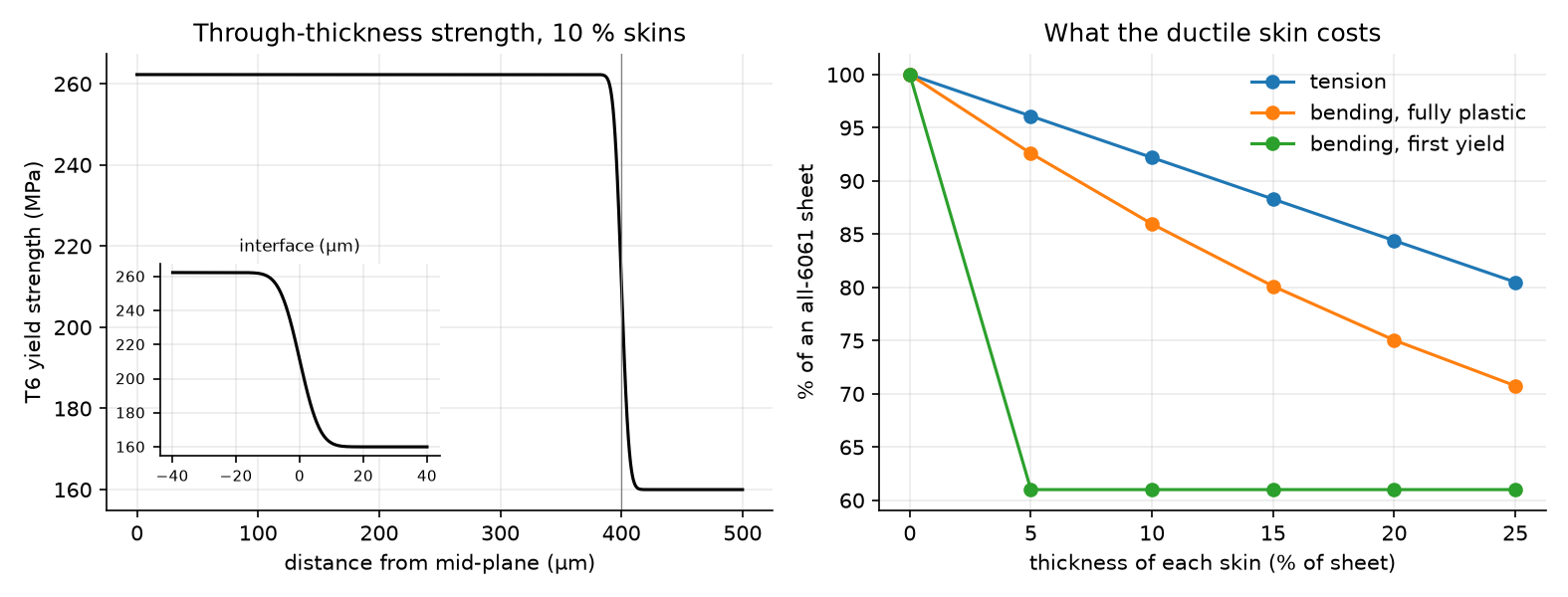
An ingot can be cast with a strong core and a softer skin, then rolled into one sheet. Three things follow, all three computed.

One furnace temperature has to suit both alloys (here 547–591 °C). The interfaces blur over 13 µm, set by the last 30 seconds of heat treatment rather than the 10 hours spent in the ingot, because rolling squeezes the earlier mixing by a factor of 600. And in bending the surface yields first: a softer skin lowers that limit by the same amount however thin it is.

Through-thickness strength of a core-and-skin sheet, and the strength kept in tension and bending against skin thickness
6061 core, 6063 skins, 1 mm sheet.

How it works

One material state, handed from model to model

Each model reads what the previous one produced and adds its own part: which phases, how much solute is left in the matrix, which precipitates of which size, what strength.

M1

Thermodynamics

Equilibrium phases and Scheil solidification (CALPHAD, COST 507 database, pycalphad).

M2

Precipitation

Nucleation, growth and coarsening of needle-shaped β″ (Kampmann–Wagner numerical model).

M2

Strength

Dislocations shearing small precipitates and bypassing large ones, plus solid solution.

Sheet

Multi-alloy sheet

Interdiffusion at the interfaces, strength through the thickness, tension and bending.

Published physics

Every model and every parameter comes from a cited paper or database.

Checked against measurement

Each model has a validation notebook that compares it with published measurements, and automated tests keep the comparison true.

Clear about its limits

When a database cannot represent a phase, or a model does not transfer to another alloy, the notebook shows it and explains why.